Budapest's Chain Bridge: Free to Walk, Closed to Cars, and the Lions Do Have Tongues
Updated 21 September 2026 · Traffic rules checked against Hungarian sources, because the English ones are out of date
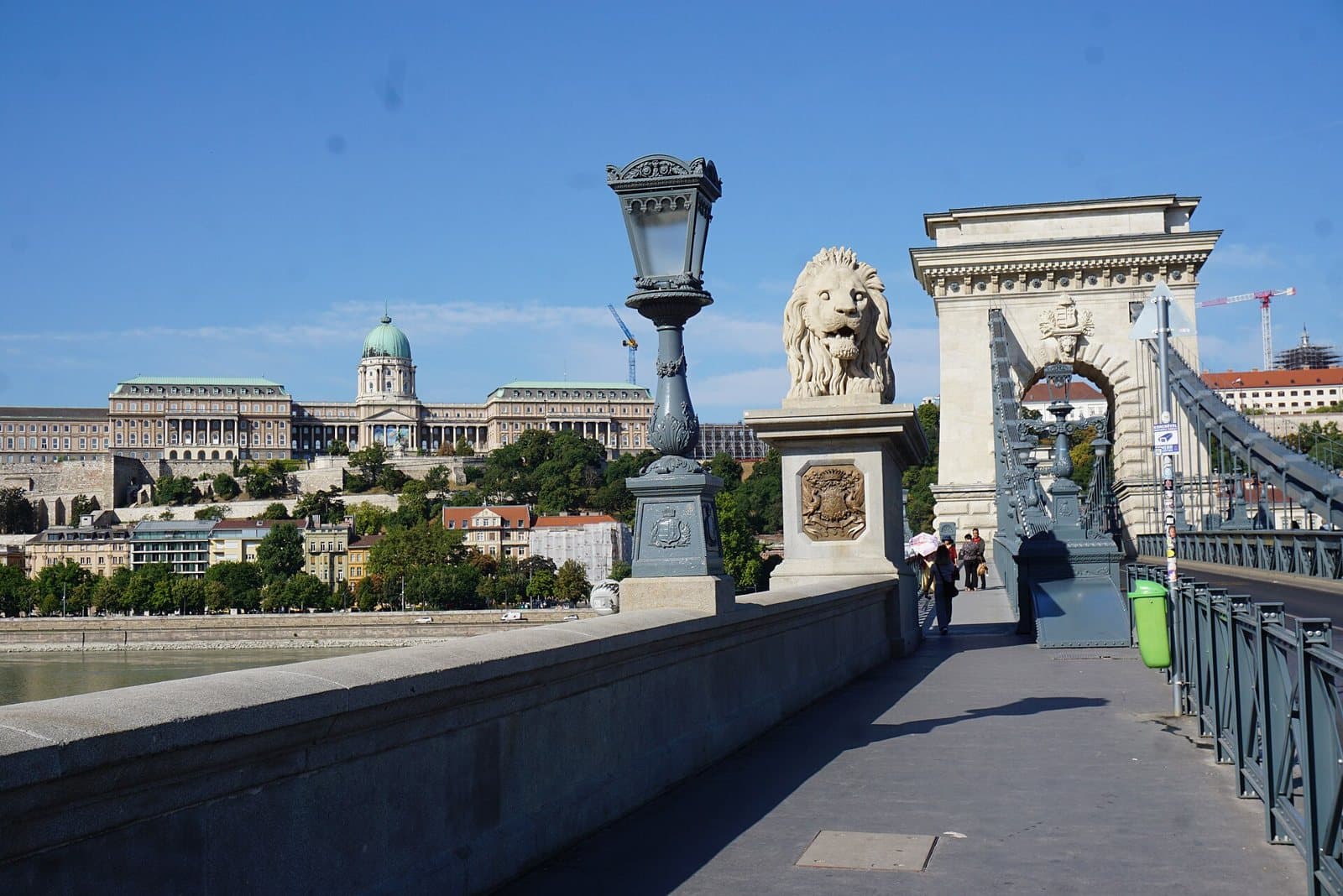
Most English-language guides still describe the Chain Bridge as a road bridge you can drive, or a traffic bottleneck to be avoided. That stopped being true on 4 August 2023, when the bridge reopened after its renovation and private cars were banned from it for good.
It is free, it takes five minutes, and it is probably the single best thing you can do in Budapest for nothing. Here is what actually applies now.
- No private cars, permanently, since August 2023. Buses, taxis, motorbikes and bicycles only.
- Free, always open, pavements both sides. No ticket exists.
- 375 metres, about five minutes, or fifteen with photographs.
- Summer weekends it goes fully pedestrian, buses and taxis included.
- The lions do have tongues. You just cannot see them from below.
You cannot drive it, and that is recent
The Chain Bridge spent most of its modern life as a congested two-lane road. It has the narrowest carriageway of any bridge in Budapest, one lane each way, and it is the only public bridge in the city with no main roads feeding directly into it, just a roundabout square at each end. The result was predictable.
Here is how it changed, because the dates matter if you are reading older advice.
| Date | What changed |
|---|---|
| 4 January 2020 | Weight limit of 5 tonnes, except city buses |
| 25 June 2020 | Speed limit cut to 30 km/h |
| Spring 2021 | Closed to pedestrians for the works |
| 16 June 2021 | Closed to vehicles, expected to last 18 months |
| 16 December 2022 | Reopens, but only to city buses, taxis and cyclists. No cars |
| Summer 2023 | A public consultation on whether cars should come back |
| 4 August 2023 | Reopens to pedestrians at midday. Private cars banned permanently |
So what can cross it today: city buses, taxis, motorcycles, bicycles and people on foot. Not private cars. If you have hired a car, the crossings you want are Erzsébet Bridge or Margaret Bridge.
The ban remains politically contested in Budapest, and it is worth saying that rather than pretending it is settled. One critical outlet, citing BKK figures, reported that the new arrangement removed some 19,600 vehicles a day from the bridge, which is either the point of the policy or the problem with it depending on who you ask. We could not reproduce that figure in a BKK source directly, so treat it as their number rather than ours.
For a visitor, none of that argument matters much. What matters is that the deck is quieter than any photograph taken before 2023 suggests, and that walking it is now a genuinely pleasant thing to do rather than an exercise in traffic fumes.
Walking it: how long, and what is at each end
The bridge is 375 metres long and 14.8 metres wide, with a pavement on each side. Five minutes at a walking pace. Fifteen in practice, because you will stop.
The Pest end is Széchenyi Square, with the Gresham Palace and the Hungarian Academy of Sciences on it, and the Parliament a few minutes north along the embankment.
The Buda end is Clark Ádám Square, and this is the more useful one to know about. It is where the funicular up to Buda Castle starts, and where the tunnel bores straight through Castle Hill. Which means the obvious move is to walk the bridge from Pest and go straight up to the castle, either on the funicular or on the free path beside it. Our Buda Castle guide has the funicular prices and the case for skipping it.
The two pavements are not equivalent for photographs. The downstream side, on your right walking from Pest, gives you Buda Castle rising over the bridge tower. The upstream side gives you the Parliament. Most people walk one way and come back the other, which costs ten minutes and is the right call.
Summer weekends, when it belongs to people
This is the detail we would most like to have known in advance, and it is in the Hungarian record rather than the English one. On weekends through the summer months, and on certain public holidays, the bridge is closed to vehicle traffic altogether and given over to pedestrians. Not just cars, which are gone anyway: the buses and taxis too.
That turns a 375-metre walk with a bus going past into an open deck, and it is the version of the Chain Bridge worth planning around if your dates allow. The city does not publish a tidy calendar of these closures far ahead, so it is a case of looking at BKK's site for the weekend you are there, or simply noticing when you walk down to Széchenyi Square that nothing is moving on it.
The lions, the tongues and the Trafalgar Square question
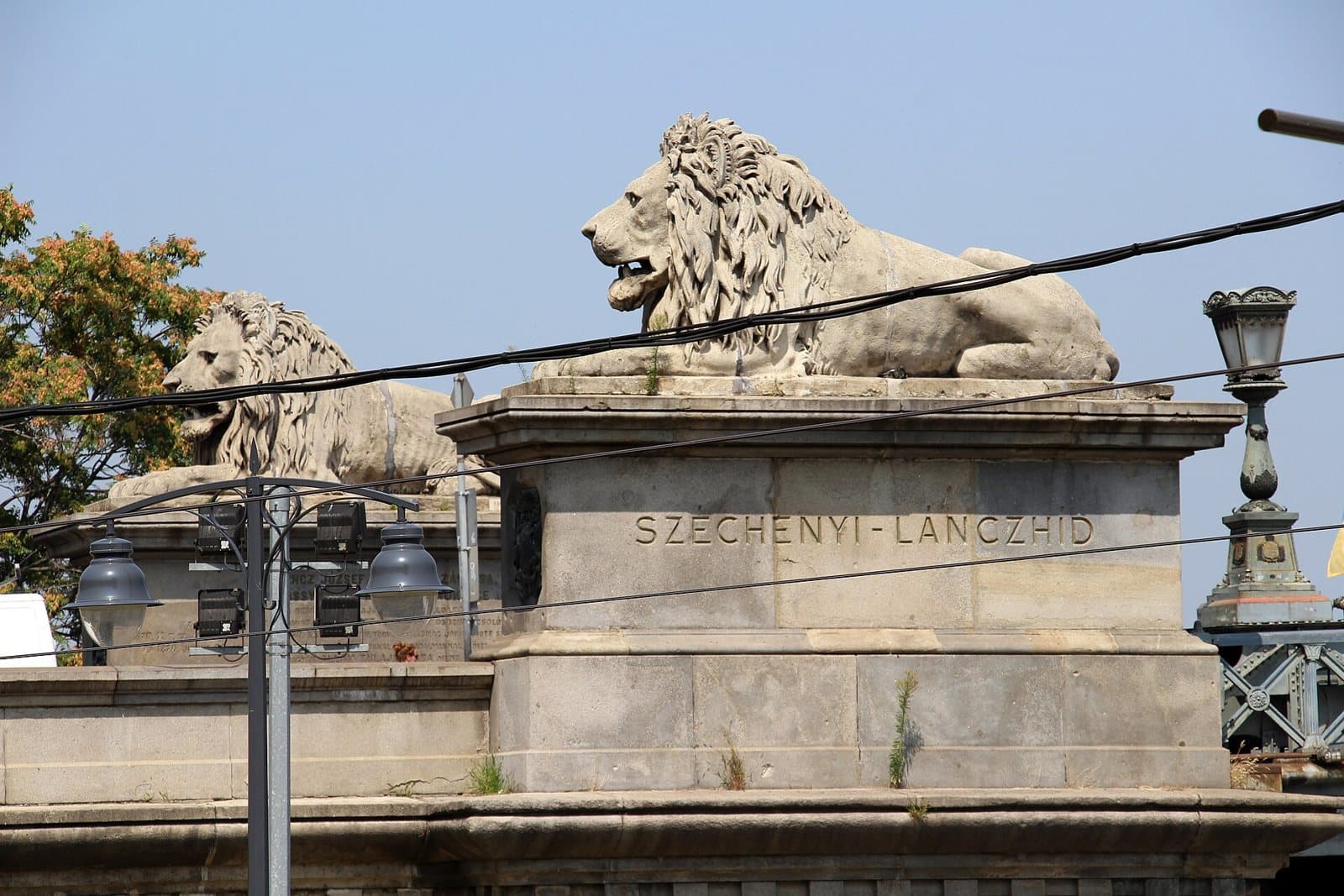
Four stone lions guard the ends of the bridge. They were carved by János Marschalkó and installed in 1852, three years after the bridge itself opened.
Every guide in Budapest will tell you the legend: that the sculptor forgot to give them tongues, that a child pointed it out at the unveiling, and that he threw himself into the Danube in shame. It is a very good story and it is not true on either count. Marschalkó did not drown himself, and the lions do have tongues. They are carved inside the open mouths, and they cannot be seen from the pavement because of the angle you are looking from. Stand back, look up from further away, or just take our word for it.
The better lion fact is one that almost nobody mentions, and it runs the opposite way round to what a British visitor would assume. The bronze lions in Trafalgar Square are similar in design to these, and they came afterwards: the Budapest lions went up in 1852, while the Trafalgar Square ones were commissioned in 1858 and not installed until 1867. London copied Budapest, not the other way about.
The bridge has been on the Hungarian 200 forint coin since 2012, and it opens the video for Katy Perry's "Firework", which is the kind of fact that turns out to settle arguments.
Two Clarks, and a plaque about a bridge in England
The Chain Bridge was designed by William Tierney Clark, an English engineer, and built by Adam Clark, a Scottish engineer. They were not related, which is the sort of coincidence that sounds invented. Adam Clark stayed in Hungary, married a Hungarian, and got the square at the Buda end named after him.
There is a plaque on the Pest side commemorating something specific and rather touching: this bridge and Marlow Bridge in Buckinghamshire are the only two surviving bridges designed by Tierney Clark. If you have walked over the one in Marlow, you have walked over the Chain Bridge's small English sibling, and the resemblance is obvious once you know.
Construction ran from 1840 to 1849. The central span of 202 metres was among the largest in the world when it was built.
Opened in the worst week imaginable
The Chain Bridge was the great project of Count István Széchenyi, the reformer whose name it carries, and it was meant to be the symbol of a modernising, self-confident Hungary. The timing did not cooperate.
It opened on 20 November 1849, months after the Hungarian revolution of 1848 to 1849 had been crushed. The ceremony was performed by Haynau, the Austrian general who had overseen the reprisals, as a deliberate humiliation. Almost nobody came. The record notes that the crowd consisted of assembled soldiers and a few passers-by, that the mood was not celebratory, and that no speech was made at all. The date carved at the Buda bridgehead is 21 November, which is not the opening but the day they started charging the toll.
That toll, incidentally, was charged to everyone, nobility included, which was one of the quietly revolutionary things about the bridge. The schedule scaled by what you were bringing with you: one rate to walk across, double if you were carrying a load, more again if you were leading a cow.
It was blown up on 18 January 1945 by retreating German forces during the Siege of Budapest, leaving only the towers standing. It was rebuilt and reopened in 1949, on its hundredth anniversary. The Shoes on the Danube Bank memorial, ten minutes north along the same embankment, commemorates what was happening in the city in the weeks before the bridge came down.
Which Budapest bridge for what
Once you know the Chain Bridge has no cars, the obvious next question is which one does. Here are the four central crossings and what each is actually for, because they are not interchangeable.
| Bridge | What crosses it | Why you would use it |
|---|---|---|
| Chain Bridge | No private cars. Buses, taxis, bikes, people | The walk, the lions, the castle view. The one you came for |
| Elisabeth Bridge | Six-lane road bridge | Driving. The white one, and the quickest way across by car |
| Liberty Bridge | Trams and road vehicles | The prettiest ironwork, green with Turul birds on the towers. Lands by the Great Market Hall |
| Margaret Bridge | Two road lanes, plus trams | The only way onto Margaret Island, and the best wide view of Parliament |
The practical upshot for a visitor on foot: walk the Chain Bridge for the view and the Liberty Bridge for the structure. The Liberty Bridge is the one whose ironwork you can actually look at while crossing, and it puts you at the door of the Great Market Hall on the Pest side. The Elisabeth Bridge is a fine thing to photograph and a dull thing to walk.
Practical details
| Detail | |
|---|---|
| Cost | Free. No ticket exists |
| Open | Always. It is a public bridge |
| Who can cross | Pedestrians, cyclists, city buses, taxis, motorcycles. No private cars |
| Length | 375 m, about 5 minutes on foot |
| Pest end | Széchenyi Square. Metro M1 to Vörösmarty tér, then a short walk |
| Buda end | Clark Ádám Square, where the castle funicular starts |
| Best for photographs of the castle | The downstream pavement, walking from Pest |
| Best for photographs of Parliament | The upstream pavement |
| Quietest | Early morning, or any summer weekend it is closed to vehicles |
The other classic way to see it is from the water, since it sits between the two things everyone photographs. Our Danube cruise guide covers what that costs and which operators are worth it, and things to do in Budapest puts the bridge in order against everything else that is free.
Frequently asked questions
Can you drive across the Chain Bridge in Budapest?
No. Private cars were permanently banned when the bridge reopened on 4 August 2023 after its renovation. Buses, taxis, motorcycles and bicycles can cross, and so can pedestrians on the pavements on both sides.
Is the Chain Bridge free to walk across?
Yes. It is free and open at all hours, with a pavement on each side. There is no ticket of any kind, which makes some listings that mention Chain Bridge tickets rather confusing: those are tours or cruises that pass it.
How long does it take to walk across the Chain Bridge?
The bridge is 375 metres long, so about five minutes at a normal pace, or fifteen if you stop for photographs, which most people do. It lands on Széchenyi Square in Pest and Clark Ádám Square in Buda.
Do the lions on the Chain Bridge have tongues?
Yes, they do. The famous Hungarian legend says the sculptor forgot them and threw himself into the Danube in shame. The tongues are there; they simply cannot be seen from pavement level, which is where everyone looks from.
When was the Chain Bridge renovated?
Between 2021 and 2023. The work took two years and five months, cost 26.7 billion forint, and finished about six weeks ahead of schedule. It reopened fully to pedestrians at midday on 4 August 2023.
Who built the Chain Bridge?
It was designed by the English engineer William Tierney Clark and built by the Scottish engineer Adam Clark, who were not related. It was Hungary’s first permanent bridge across the Danube, opened in 1849 after nine years of construction.
Is the Chain Bridge closed to traffic at weekends?
On summer weekends and certain public holidays the bridge is closed to vehicle traffic altogether and handed over to pedestrians, so the buses and taxis go too. That is the best time to walk it if you want the deck to yourself.
What is at each end of the Chain Bridge?
Széchenyi Square in Pest, next to the Gresham Palace and the Hungarian Academy of Sciences, and Clark Ádám Square in Buda, where the funicular up to Buda Castle starts and the tunnel runs under Castle Hill.