Great Market Hall: The Sunday Trap, and Which Floor Is the Tourist Trap
Updated September 2026 · We counted all 208 traders the city operator lists
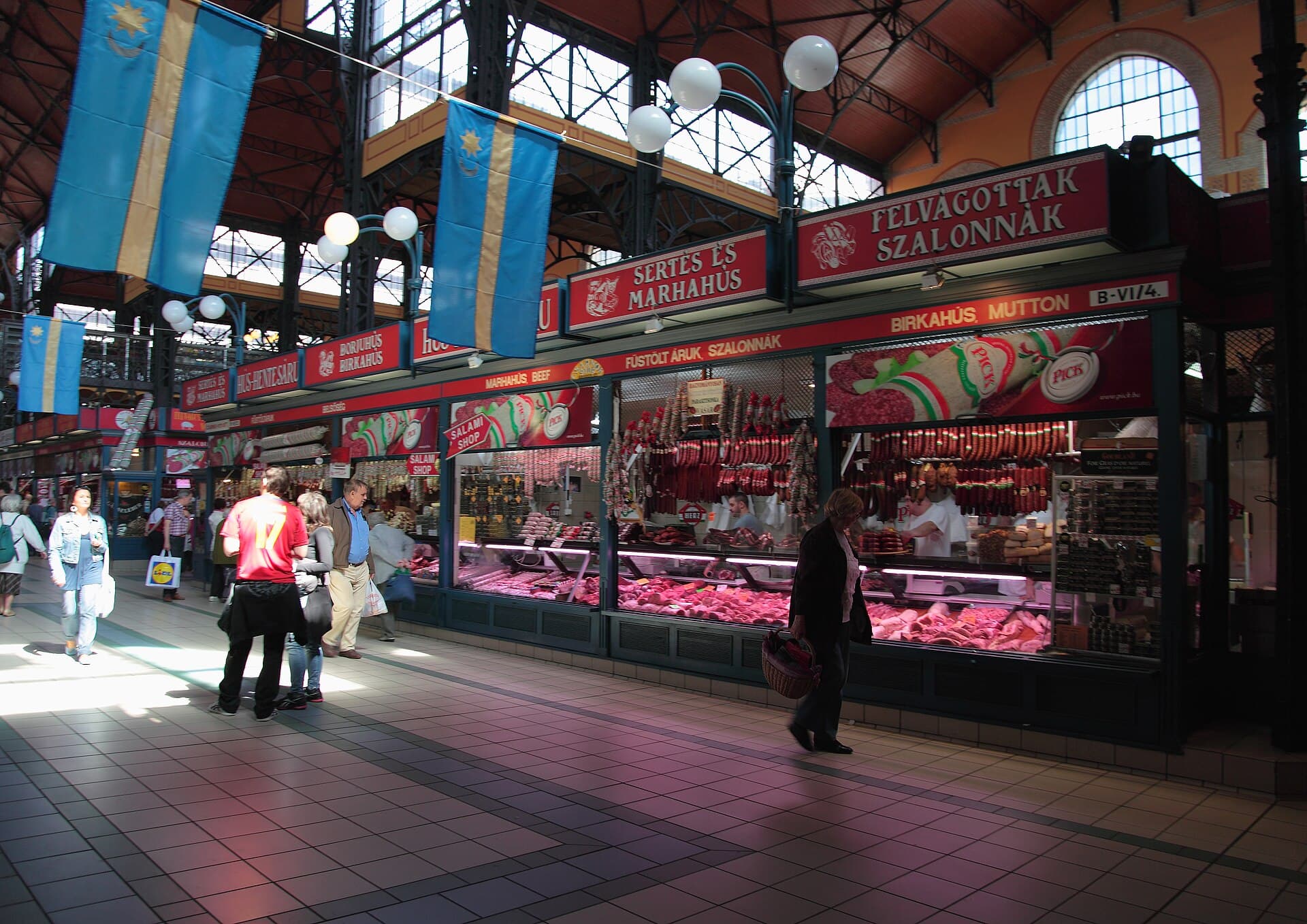
Search for this place and two of the results on the first couple of pages ask, in so many words, whether it is worth bothering with: one video titled "Worth Visiting or Not?", one guide promising to warn you about the tourist traps. That is the real question behind a lot of the traffic, and it usually gets answered with an opinion.
We thought it could be answered with a count instead. The city operator that runs the hall publishes a listing for every single trader inside it, with their floor, their trade and their opening hours. There are 208 of them. Here is what they add up to.
- It is free to enter. No ticket, nothing to book.
- Do not go on a Sunday. The building opens, but of the 118 traders who publish hours, exactly one opens on Sunday.
- The tourist trap is one floor. 29 of the 30 souvenir shops are upstairs. The ground floor has none.
- Go early on a weekday. It opens at 06:00 Monday to Friday and it is a real market at that hour.
- Wikipedia has the hours wrong, and it ranks third for this.
Free, and still a working market
The operator states it in capitals on its own page: entry is free. There is no ticket, no queue and nothing to book in advance, which already separates it from most of what gets called an attraction in this city.
That matters for how you treat it. This is not a heritage site that happens to sell food; it is the city's main indoor food market, opened in 1897, that happens to be beautiful. Of the 208 units inside, 136 sell food or feed you, about two thirds. People still do their shopping here.
The hours, and the Sunday trap
These are the building's hours, from the operator:
| Day | The building | What that actually means |
|---|---|---|
| Monday to Friday | 06:00 to 18:00 | The real thing. Stalls open from around 06:00 to 08:00 |
| Saturday | 06:00 to 16:00 | Busiest day, and stalls start closing from about 15:00 |
| Sunday | 10:00 to 16:00 | Open, and almost entirely shut. See below |
| Public holidays | Closed | The operator is explicit about this |
Now the part that is not written anywhere. The operator lists every trader with their own opening hours, because stalls are independent businesses and keep their own. Of the 208 traders, 118 publish hours. Exactly one of those 118 lists a Sunday.
That one is the Aldi supermarket in the basement.
We checked that three separate ways before writing it down, because a number that stark is usually a parsing mistake. Counting day-abbreviation lines across the whole page gives 61 Mondays, 60 Tuesday-to-Friday blocks, 75 Saturdays and one Sunday. So: turning up on a Sunday gets you into a handsome empty building with a supermarket in the cellar.
Go on a weekday morning instead. It opens at six, and the first couple of hours are the version of this place that is worth seeing, before the tour groups arrive.
Which floor is the tourist trap
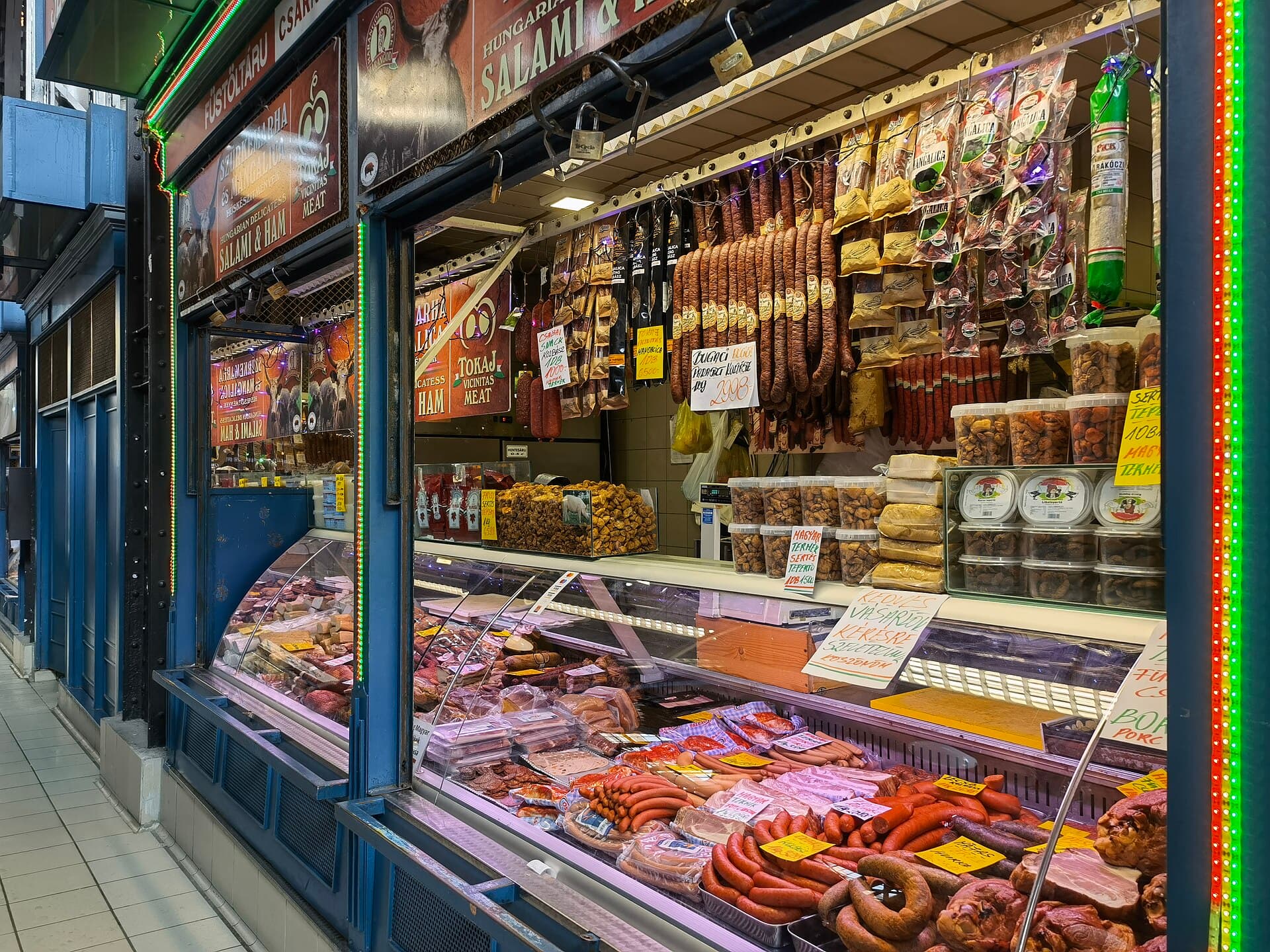
The complaint about this market is that it has been taken over by souvenir shops. We counted. The complaint is true of one floor and false of the rest.
| Floor | Units | What is there | Souvenir shops |
|---|---|---|---|
| Ground floor | 123 | 49 greengrocers, 29 butchers, 27 grocers, 8 health food, 2 dairy | None at all |
| First floor | 59 | 29 souvenir shops, 20 general, 9 places to eat | 29, or half the floor |
| Basement | 26 | Fishmongers, pickle stalls, specialist butchers, a supermarket | One |
So the shape of the place is simple, once you see it:
- Downstairs is a food market that Hungarians use, where 123 of 123 units sell something edible or useful, and not one sells a fridge magnet.
- Upstairs is a souvenir gallery with a food court attached, where roughly half the units sell gifts and nine sell hot food.
- The basement is the specialist bit, and the least visited: fish, pickles, game.
Which means the honest answer to "is it a tourist trap" is: only if you go up the stairs and stay there. Judging the whole building by its first floor is like judging a supermarket by its gift aisle.
Do you need a guide?
We should be straight about the tension here, because we earn a commission on the links below. This place is free and you can walk around it on your own in half an hour. A food tour costs €60 to €100. It will not save you money and it is not supposed to.
What it actually buys you is two things, and they are worth naming honestly:
- Language. Downstairs, where the good stuff is, a lot of the counter staff work in Hungarian. That is exactly why that floor stayed good, and it is also what makes it hard to shop in.
- Judgement. There are 49 greengrocers and 29 butchers in one room. Knowing which paprika, which sausage and which Tokaji are worth buying is the thing you are paying for.
If neither of those is a problem for you, skip the tour and read the next section instead.

Great Market Hall Chef-Led Private Tasting Tour
Two hours, private, led by a chef, and the only well-reviewed product we found that is specifically about this building rather than a city food tour that passes through it. The 4.97 rests on 78 reviews, which is a small but respectable sample. If your interest is the market itself rather than a crawl around Pest, this is the closer fit.

Budapest Food Tour: Market Walk, Local Drinks & 20+ Tastings
Two and a half hours that start in the market and carry on into the city, with more than twenty tastings and drinks. At 4.99 across 205 reviews it has the best combination of score and sample of any Budapest food tour we have checked, and it is cheaper than the better-known ones. Free cancellation.
What is worth buying
The useful rule is the one the count gives you: buy downstairs, browse upstairs. The same paprika and the same Tokaji are sold on both floors, and upstairs they sit next to the fridge magnets and are priced accordingly.
The things worth carrying home, all of which Hungary genuinely makes:
- Paprika, sweet or hot, and the difference is worth asking about. It is the one souvenir from here that a cook will actually use.
- Tokaji, the sweet wine from the northeast. Bottles travel; ask for the dry version too if you assumed it was all dessert wine.
- Dried sausage and salami, especially anything labelled Mangalica, which is the curly-haired Hungarian pig. It keeps without refrigeration, which is the point.
- Pickles from the basement, which is where the pickle stalls are and where almost no visitor goes.
One caution we are not going to dress up: we have not price-checked the stalls against each other, so we are not going to tell you that any particular counter is cheaper. What the floor plan tells you is where to start looking.
Eating upstairs
Nine of the 59 units on the first floor are places to eat, and this is the one good reason to go up. It is where the langos stalls are: deep-fried dough, traditionally with sour cream and grated cheese, and it is exactly as heavy as that sounds.
Two honest caveats. The first is that upstairs is where the prices are aimed at visitors, so this is not the cheapest lunch in Budapest. The second is that we have not eaten at these stalls, so we are not naming one as the best; anybody who does, without saying when they went, is guessing too.
If a proper Hungarian meal is what you are after rather than a snack over a railing, the ruin bar district has better options and we cover the trap-spotting for restaurants in things to do in Budapest.
Finding it
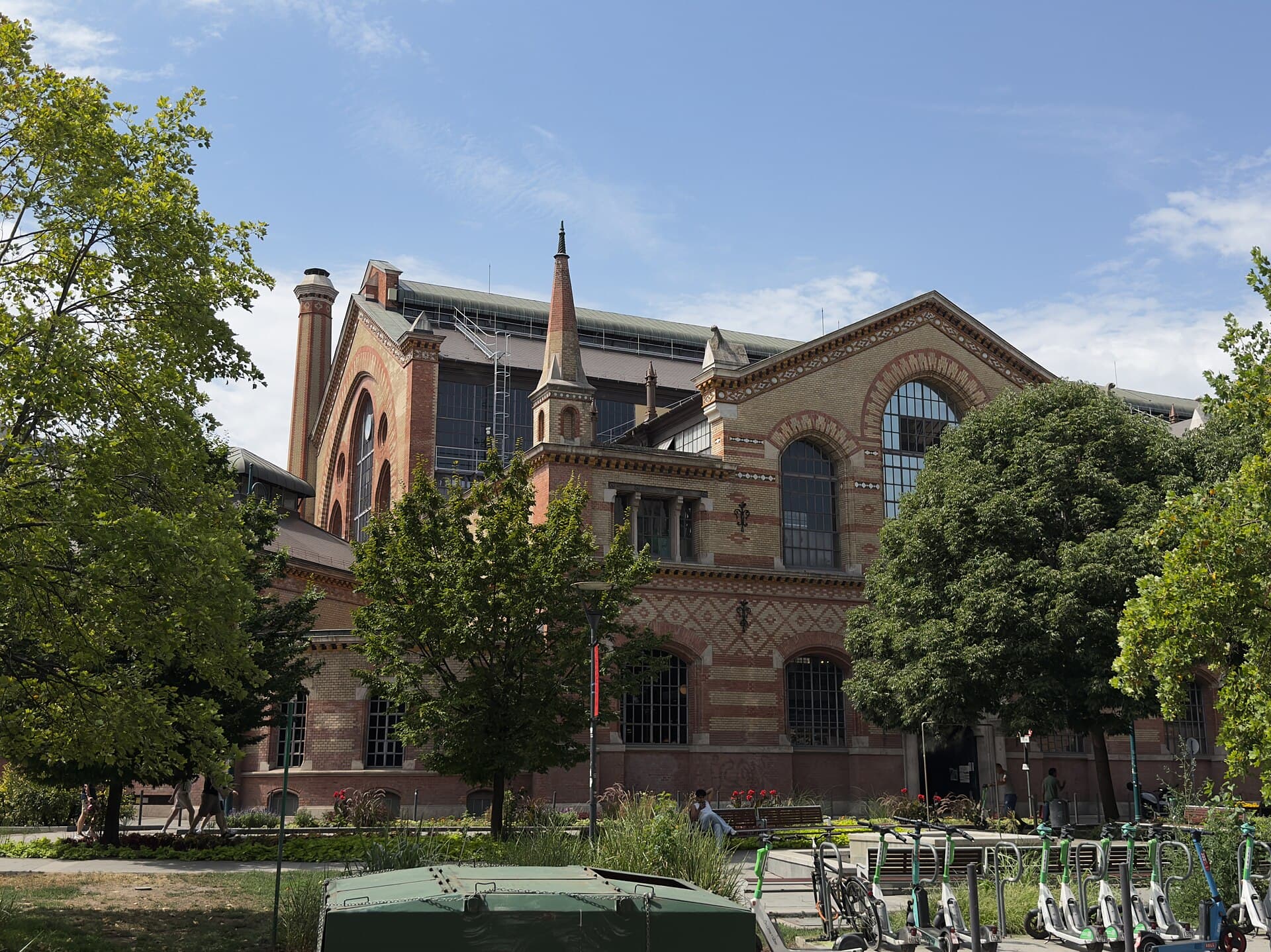
It is at Vámház körút 1-3, which is easier to find than to pronounce: it stands at the Pest end of Liberty Bridge, exactly where the pedestrian shopping street Váci utca runs out. If you walk the length of Váci utca away from the centre you arrive at the door.
- Metro M4 stops at Fővám tér, directly outside.
- Trams 2, 47, 47B, 48 and 49. Tram 2 is the one that runs along the river and is worth taking for its own sake.
- Trolleybus 83, buses 15 and 115.
The building is worth two minutes from the outside before you go in. It opened on 15 February 1897, was designed by Samu Pecz, covers 10,000 square metres under a steel frame, and its roof is tiled in Zsolnay ceramics from Pécs. It was badly damaged in the war and left to deteriorate until a full restoration began in 1991; it reopened in 1997 and took a FIABCI Prix d'Excellence two years later.
It sits naturally in a Pest day with the Basilica and the river, which is how the Budapest itinerary sequences it.
Frequently asked questions
Is the Great Market Hall free to enter?
Yes. The city operator states it plainly: entry is free. It is a working food market rather than a ticketed attraction, so there is nothing to book and nothing to queue for.
Is the Great Market Hall open on Sunday?
The building is, 10:00 to 16:00, but that is misleading. Of the 208 traders the operator lists, 118 publish opening hours and exactly one of those includes Sunday, the Aldi in the basement. You can walk in on a Sunday and find almost everything shuttered.
What are the Great Market Hall opening hours?
Monday to Friday 06:00 to 18:00, Saturday 06:00 to 16:00, Sunday 10:00 to 16:00, and closed on official public holidays. Note that individual stalls keep their own shorter hours, typically opening later and closing around 17:00 or 18:00.
Is the Great Market Hall a tourist trap?
One floor of it is. We counted every unit the operator lists: of 30 souvenir shops in the building, 29 are on the first floor. The ground floor has none at all, and is 123 units of greengrocers, butchers and food shops. The complaint people make is really about upstairs.
What should you buy at the Great Market Hall?
The things Hungary actually produces and that travel well: paprika, Tokaji wine, dried sausage and salami, and pickles from the basement. Buy them downstairs rather than upstairs, where the same goods sit next to fridge magnets and are priced for visitors.
What is on each floor of the Great Market Hall?
The ground floor is produce, meat and groceries, 123 units of it. The first floor is souvenirs and hot food stalls, 59 units. The basement holds fishmongers, pickle stalls, a few specialist butchers and a supermarket.
How do you get to the Great Market Hall?
It stands at Vamhaz korut 1-3, at the Pest end of Liberty Bridge where Vaci utca finishes. Metro line M4 stops at Fovam ter directly outside, and trams 2, 47, 47B, 48 and 49 all pass it.
Do you need a guided tour of the Great Market Hall?
No, and a tour will not save you money: entry is free and the market is easy to walk around. What a guide buys is language. Most counter staff downstairs work in Hungarian, and a guide can tell you which paprika and which sausage are worth the money.
Some links on this page are affiliate links. If you book through them we earn a commission at no extra cost to you. It does not change what we recommend. Full disclosure.